


What is a raised deck terrace made of WPC?
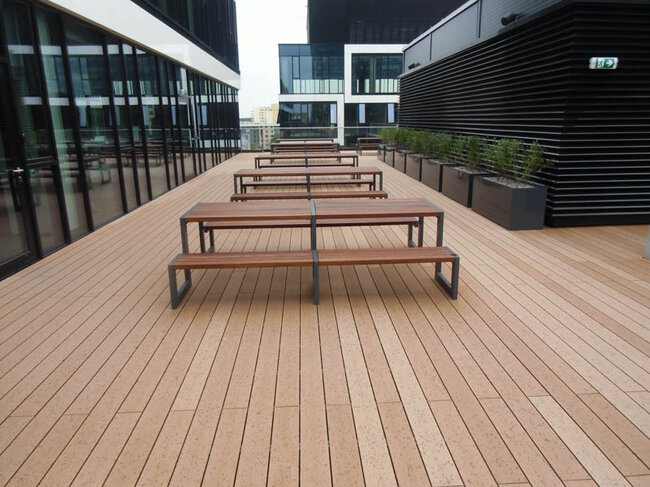
A raised deck terrace made of composite decking (WPC) is one of the most frequently chosen solutions in modern single-family and developer construction. It combines the aesthetics of wood with the durability of synthetic materials and the advantages of a structure raised on pedestals.
If you want to first understand the basics of the technology:
→ See also: What is a raised deck terrace
A raised deck terrace made of composite decking is a structure in which:
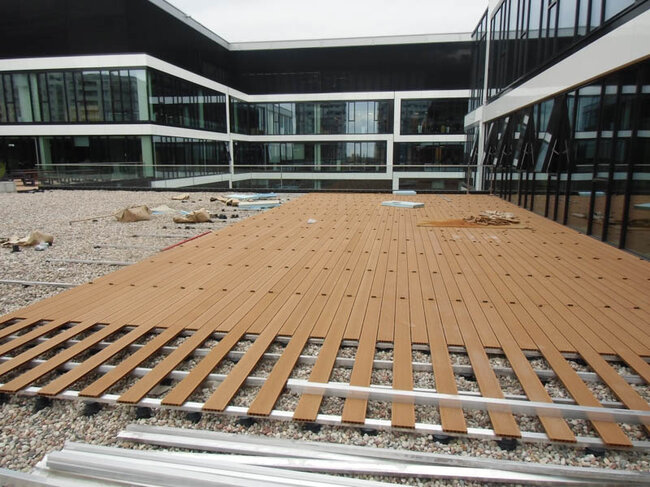
- WPC boards are mounted to joists,
- joists rest on pedestals with adjustable height
- pedestals are placed pointwise on a stable substrate
- a ventilation space is created between the board and the substrate
The lack of a permanent connection to the substrate means that the system:
- does not transfer structural stresses from the building,
- allows for free water drainage,
- permits inspection of installations under the terrace,
- protects the waterproofing from damage
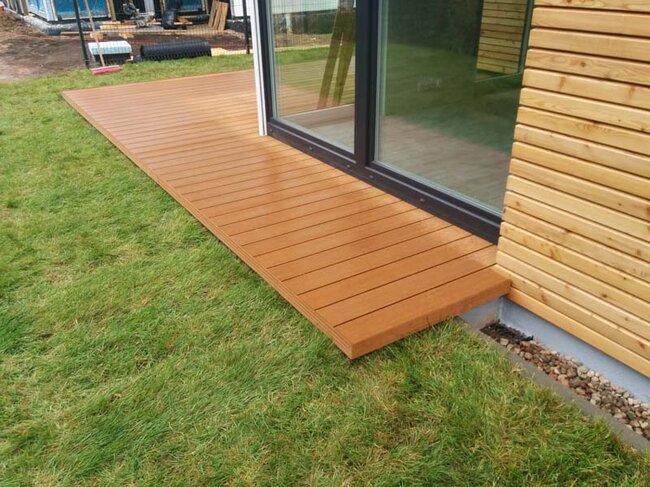
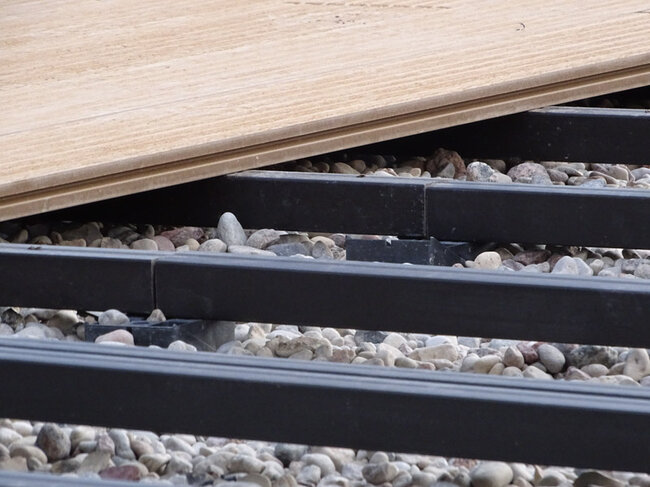
Properties of WPC Composite Decking Boards
WPC (Wood Plastic Composite) decking boards are produced from a mixture of wood flour and polymers. They combine a natural appearance with enhanced resistance to moisture and fluctuating temperatures.
The characteristic features of this material in the context of terrace use are:
- resistance to moisture and rot,
- no need for impregnation,
- dimensional stability when properly installed,
- resistance to UV radiation (depending on the manufacturer),
- ease of cleaning.
However, it should be remembered that although WPC has many features different from wood, it still reacts to temperature in the same way. Therefore, proper expansion gaps and joist spacing are of key importance.
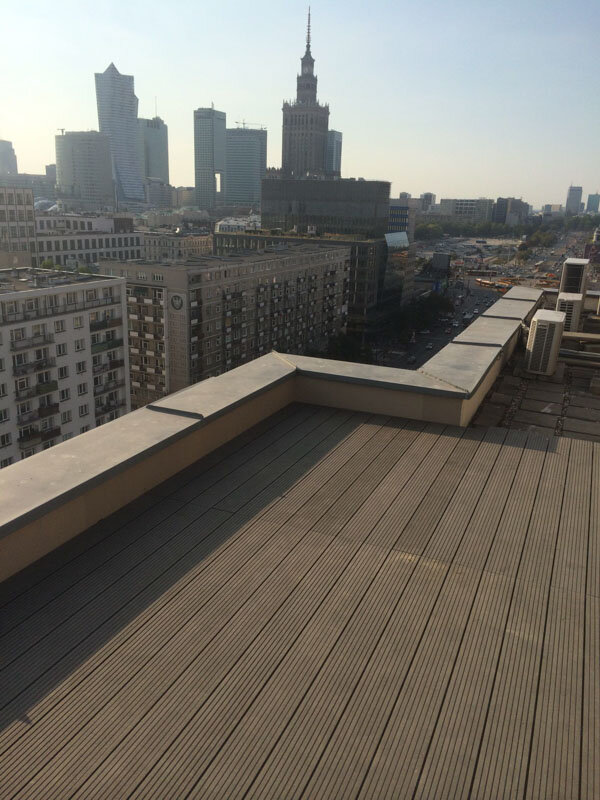
System Construction - Terrace Layers
From the top, the system consists of:
- Composite decking boards
- Joists (composite or aluminum)
- Adjustable or fixed pedestals
- Stable substrate (ground or concrete screed)
If the terrace is not on the ground - the substrate should have a slope of 1.5-2% towards the drain. The usable surface (top surface of the boards) can remain completely level, as adjustment is done at the pedestal level.
More about the structural layers:
Joist spacing and expansion joints
This is one of the most important elements of installation.
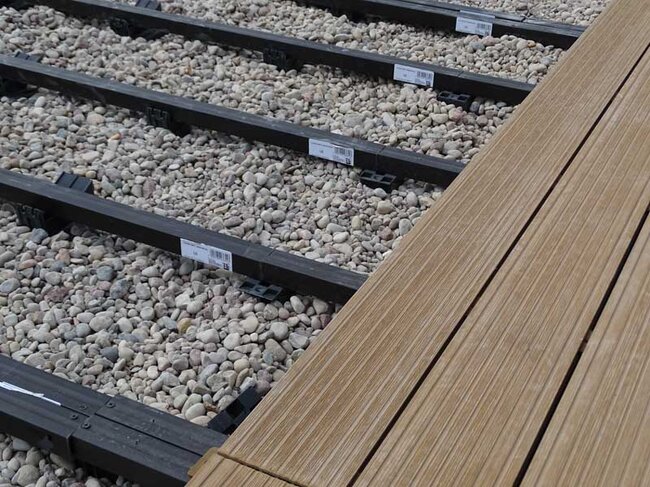
Joist spacing
The most commonly used spacing is:
- 40-50 cm (according to the deck board manufacturer's recommendations),
- in areas of increased load or critical points of the terrace (cutouts, steps, curves), densify the supports.
Too large a spacing can lead to warping of the boards, which in the long run can lead to unevenness on the terrace.
Expansion joints
Composite decking boards expand under the influence of temperature. Therefore, it is necessary to maintain:
- gaps between boards (in accordance with the installation system),
- expansion gaps at walls and fixed elements,
- end gaps when joining lengths.
The lack of proper expansion joints is one of the most common causes of deformation of a WPC deck.
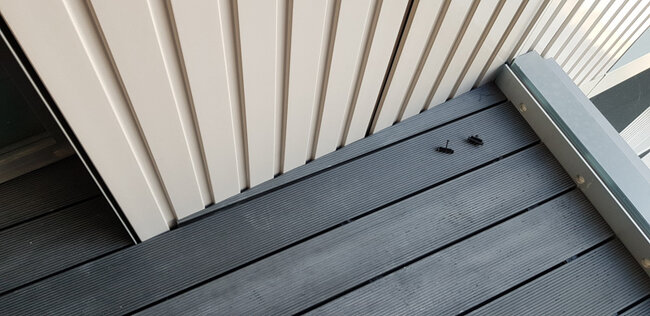
Substrate for WPC decking
Both in the case of a deck on the ground and on all other substrates, the stability of the pedestals must be ensured - they carry the main weight, so it is necessary that both their base adheres to the ground and the head to the joist.
Terrace on the ground
When installing on the ground, you should:
- remove the layer of humus,
- stabilize the substrate (using gravel, concrete slabs, blocks),
- ensure drainage,
- ensure the stability of each support point.
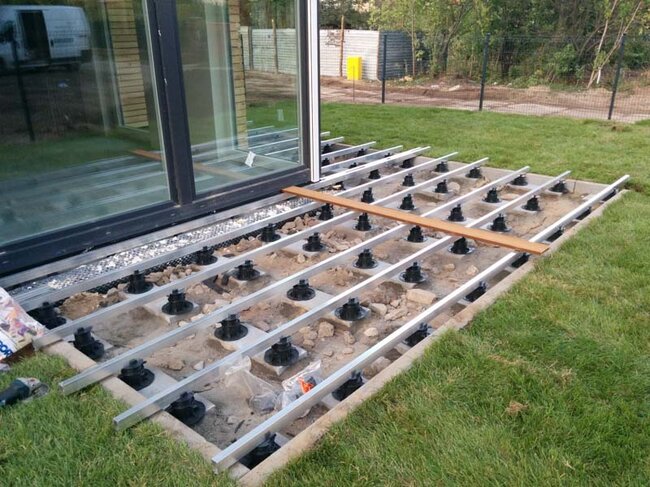
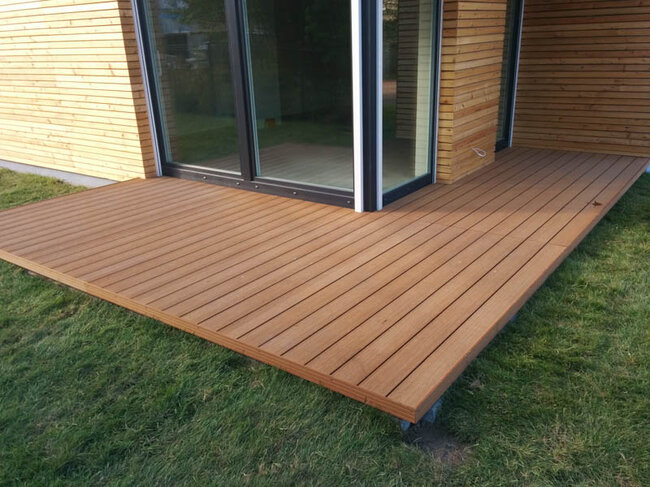
Terrace on concrete screed
The substrate should be cleaned, and the pedestals placed stably and at equal intervals. If there are any unevenness, additional SBR rubber pads can be used.
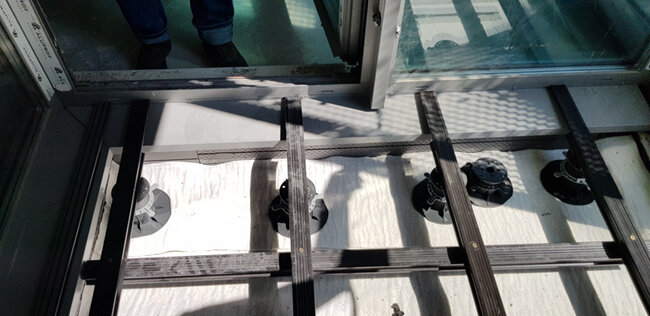
Most common mistakes with composite decking
- Joist spacing too wide
- Lack of expansion gap at walls
- Installation without maintaining slope in the substrate
- Lack of ventilation under the deck board
- Point loads without additional support
More about installation mistakes:
WPC decking vs. wooden decking
Feature: WPC | Wood
Maintenance: Does not require impregnation | Requires regular impregnation
Stability: Higher when properly installed | Depends on the species
UV resistance: Resistant | Depends on impregnation
Moisture resistance: High | Variable
Natural appearance: Styled to look natural | Natural
WPC decking vs. porcelain tile decking
Compared to ceramic tiles:
- WPC provides a warmer visual effect,
- porcelain tile offers greater scratch resistance
- the system construction remains the same (joist vs. point support)
Comparison of systems:
→ See also: Elevated terrace with ceramic pavers - 2 cm ceramic tiles
Why investors choose WPC in a raised deck system?
- fast "dry" installation,
- no risk of delamination as in glued systems,
- possibility of dismantling a single element,
- easy inspection of waterproofing,
- lower system weight,
- possibility of running installations under the terrace.
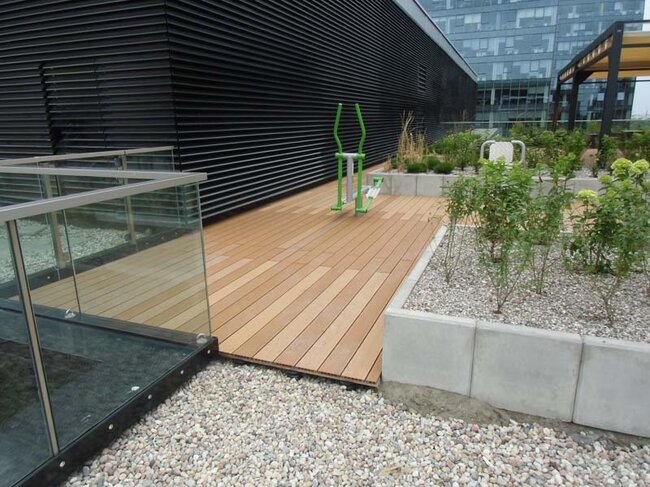
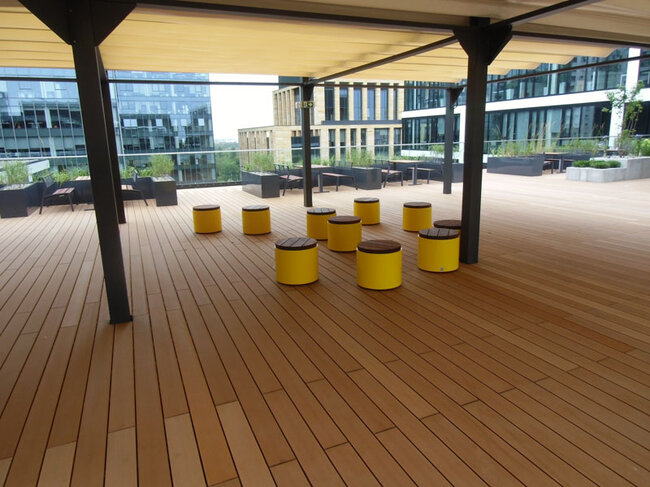
For projects where a "warmer" effect on the terrace matters, WPC decking boards are the most frequently chosen finishing material for raised deck terraces.
Summary
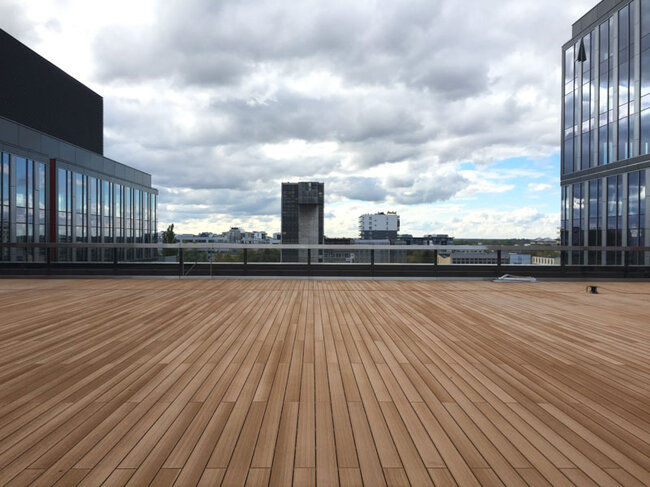
A raised deck terrace made of composite decking boards is a system solution that:
- protects the building's structural layers,
- enables effective drainage,
- provides service access,
- allows for height adjustment,
- eliminates problems typical of glued terraces.
Durability is determined not only by the material, but also by proper installation, maintaining expansion joints, and the correct spacing of supports.
If you want to better understand how the entire system works:
FAQ
Can composite decking boards be installed directly on the ground?
No. They always require a stable substructure and point support.
What spacing for joists with WPC?
Most often 40-50 cm, according to the manufacturer's recommendations.
Do WPC boards need to be glued?
No. They are mechanically mounted to the joists.