


Location: Dubai Safari Park, Dubai, United Arab Emirates
Type of facility: public recreational space
Scope of work: raised floor fountain surface
Surface: stone pavers of varying dimensions
Mounting system: adjustable terrace pedestals SOLVER MAX
Main requirements: stability, access to installations and adaptation to circular geometry
Challenge – Surface Above a Fountain Installation
Adjustable pedestals are most commonly used in the construction of raised deck terraces and rooftop decks. However, the project at Dubai Safari Park shows that the system can also be used in more demanding structures.
In the central part of the publicly accessible plaza, a floor fountain was built with a surface made of massive stone pavers. Beneath the pavers lay technical infrastructure including water and electrical installations, drains, conduits, and components powering the nozzles.
The use of adjustable pedestals made it possible to create a stable surface above the installations, maintain service access, and align the level of the pavers with the surrounding plaza.
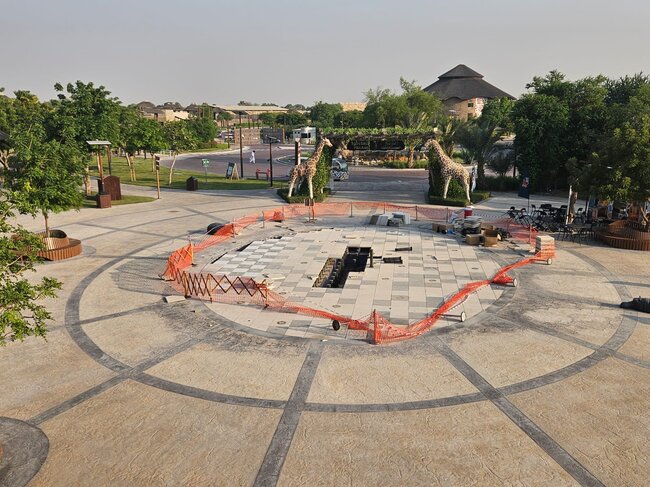
The fountain was designed as an integral part of the plaza. After completion of the works, its surface was to form a single plane with the surrounding flooring, while all technical infrastructure was to remain hidden beneath the pavers.
The project had to account for installations running beneath the surface, nozzles and inspection elements, the circular outline of the fountain, and pavers of various sizes and shapes. The structure was intended for an intensively used public space, so it required adequate stability and a large number of support points.
Traditionally gluing the pavers would have significantly hindered access to the installations. Every inspection or repair would have required chipping away the surface and replacing its fragments.
Solution – pavers on adjustable pedestals
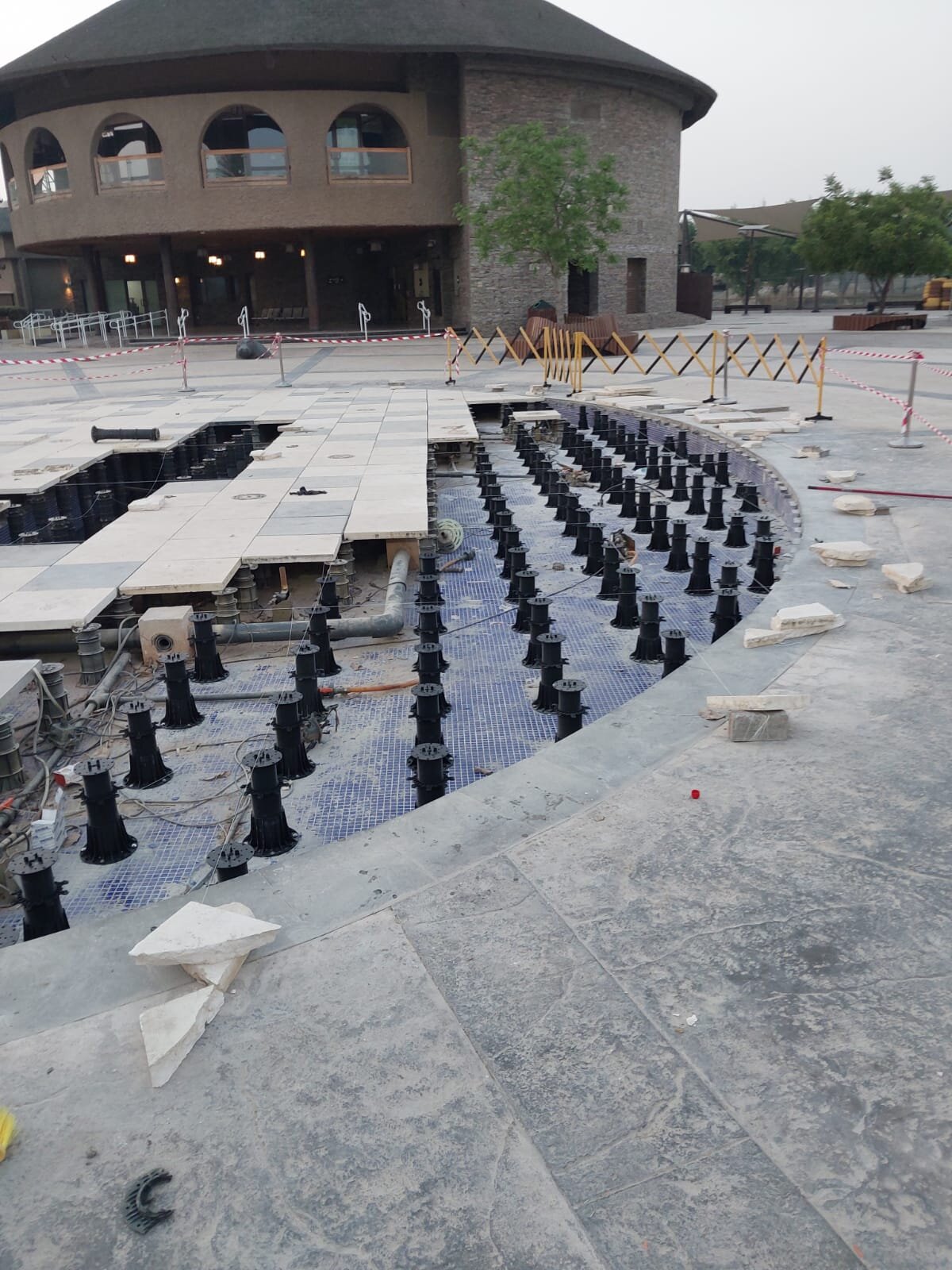
Stone elements were laid on individually adjustable pedestals. An open technical space was created beneath the surface for pipes, conduits, drains, and fountain power supply components.
The height of each pedestal was adjusted to the local ground level and the target elevation of the plaza. This made it possible to achieve an even surface despite the extensive infrastructure below.
The placement of the supports was adapted to the layout of the pavers and the location of technical equipment. Additional pedestals were used under elements with larger dimensions, irregular shapes, or increased load.
Adapting to Circular Geometry
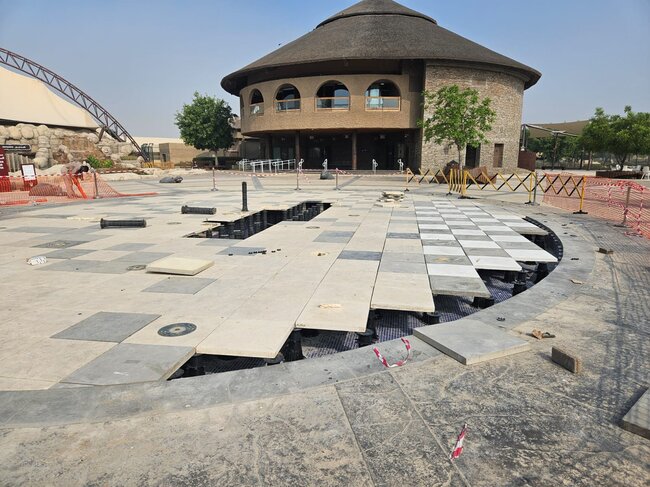
The fountain has a circular outline, while most of the pavers are rectangular or square. The elements near the outer edge therefore required individual cutting.
The pedestals were placed both under the corners and under the irregular paver sections along the curved edge. Height adjustment made it possible to maintain a single plane, even joints, and a smooth connection between the fountain and the surrounding plaza surface.
Stability of Heavy Stone Pavers
The surface was made of massive pavers designed for intensive use. A properly planned number of supports helped limit deflection and evenly transfer loads to the substrate.
The wide bases of the pedestals distribute pressure over a larger surface area, while individual adjustment allows for the elimination of gaps between the supports and the pavers. This resulted in a stable surface suitable for use in public spaces.
Access to technical infrastructure
The most important advantage of the system is the ability to lift selected pavers without damaging the surface. This allows quick access to water installations, nozzles, drains, pipes, and inspection elements.
After the inspection or repair is completed, the pavers can be reinstalled in the same place. This limits the fountain's downtime and reduces the costs of later servicing.
Integration of nozzles with the surface
The elements responsible for the fountain's operation have been integrated with the stone paving. Their placement had to be precisely coordinated with the layout of the pavers, joints, and pedestals.
The system enabled independent adjustment of the surface height and precise execution of openings around the nozzles, drains, and inspection covers. The technical elements remained functional without disturbing the orderly appearance of the square.
Installation without adhesive
The pavers were laid dry, without permanent bonding to the substrate. This allowed for multiple adjustments of their position while coordinating the height of the pedestals, the routing of installations, and the location of the nozzles.
The absence of an adhesive layer also facilitates later service disassembly and reduces the risk of damage to the stone elements.
Project Implementation
The work included determining the target height of the fountain, planning the installation and layout of the pavers, arranging the pedestals, and individually adjusting their heights. Next, holes were made for technical elements, the pavers were fitted to the circular edge, and additional supports were used under the cut elements.
The installation was carried out in stages, maintaining access to the infrastructure until the last sections of the surface were laid.
Why were adjustable pedestals used?
The system provided access to installations without damaging the flooring, precise height adjustment, and the ability to route infrastructure beneath the pavers. It also made it possible to support elements of various sizes and shapes, and to carry out installation without adhesive or mortar.
The appropriately planned number of pedestals ensured the stability of heavy pavers in an intensively used public space.
Result – fountain integrated with the square
After the installation was completed, the fountain surface was connected with the surrounding square into one orderly plane. The installations and support structure remained invisible, but still easily accessible during maintenance work.
The project at Dubai Safari Park shows that adjustable pedestals can be used not only on terraces. They also work well under fountain surfaces, squares, and other structures where heavy pavers must be connected with extensive technical infrastructure.