As a manufacturer of adjustable pedestals, we regularly consult with architects, contractors, and homeowners who are trying to consider these three finishing materials. Each material brings distinct advantages, aesthetic qualities, and maintenance requirements to a terrace supported on pedestals.
Here is a practical comparison to help you choose the right surface for your project.
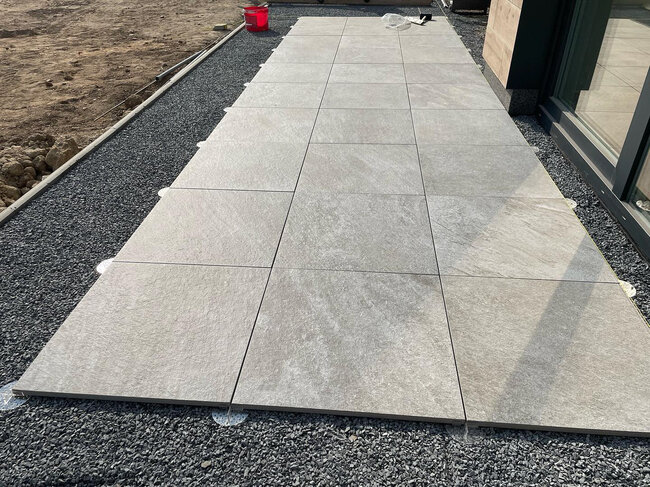
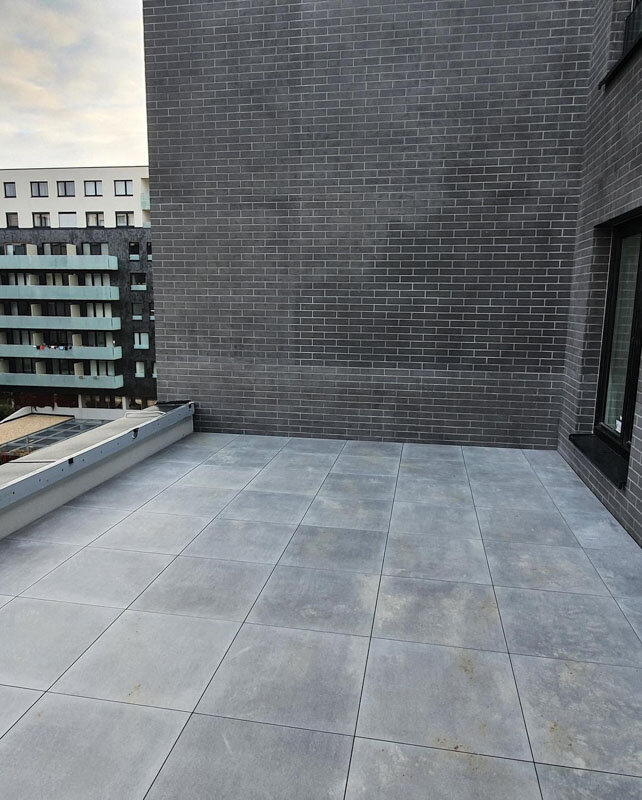
1. Porcelain pavers: lightweight, uniform and easy to maintain
Porcelain has become one of the most popular choices for raised outdoor floors and not without reason. Designed specifically for outdoor use (typically 20 mm or ¾ inch thick), porcelain pavers offer high performance with very low maintenance costs.
Why it works well on pedestals
- Uniform dimensions: Porcelain pavers are manufactured in precise, repeatable dimensions and thicknesses. This uniformity makes leveling over large areas easier and ensures even, clean spacer gaps.
- Low weight: Compared to thick natural stone, porcelain offers high structural strength while remaining relatively lightweight. This helps keep the overall dead load low on roofs with limited load capacity.
- Weather and stain resistance: Non-absorbent porcelain resists moisture absorption, which prevents frost damage, moss growth, and deep stains from oil or red wine.
Potential trade-offs
- Impact consideration: Although durable under distributed foot traffic, thin porcelain requires appropriate pedestal spacing or central support pads for pavers to safely withstand large point loads.
- Aesthetic impression: Modern porcelain effectively imitates wood, slate, or concrete, but purists who prefer organic variation may still lean toward genuine stone or wood.
2. Natural stone: Timeless elegance and high durability
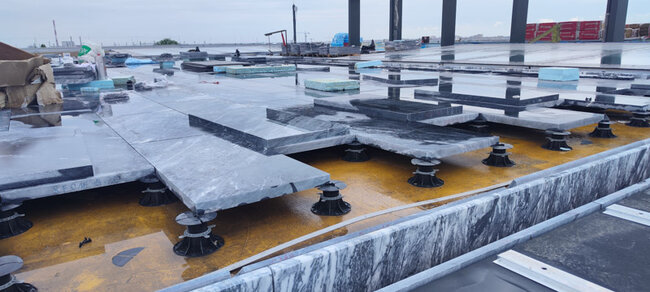
Granite, basalt, limestone and dense sandstone bring a natural texture and weight that manufactured materials are unable to fully replicate.
Why it works well on pedestals
- Uneven aesthetic depth: Each piece of natural stone has a unique grain, color variations, and rich texture.
- High load-bearing capacity: Thick natural stone pavers have significant mass and flexural strength, making them perfectly suited for heavily used commercial plazas.
Potential trade-offs
- Differences in thickness and weight: Unlike factory-produced tiles, natural stone pavers may vary slightly in the thickness of individual pieces. When installing on terrace pedestals, it is sometimes necessary to use slope correctors or shims to achieve a perfectly level surface.
- Weight limits: The considerable weight of natural stone requires careful structural verification of the substrate or roof before installation.
- Maintenance requirements: Porous stones require sealing to prevent stains and water penetration in environments exposed to freeze-thaw cycles.
3. Concrete pavers / Terrace pavers: Durability under heavy foot traffic and cost-effective performance
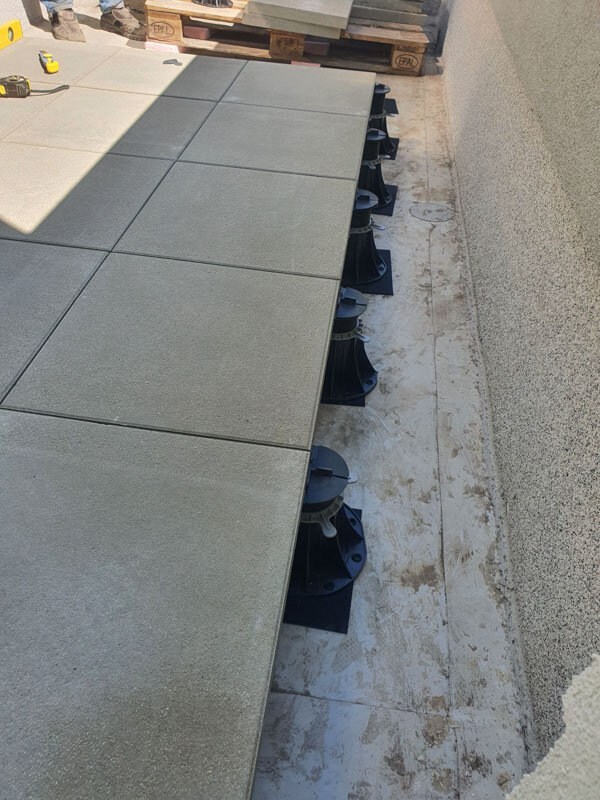
Concrete pavers are durable and cost-effective pavers designed to provide high load-bearing capacity and excellent slip resistance for raised floor systems. They are a long-lasting solution for high-traffic commercial plazas, public walkways, and rooftop terraces.
Why they work well on pedestals
- High load-bearing capacity: Concrete pavers are characterized by high compressive strength, which makes them ideal for high-traffic commercial spaces, public squares, and areas requiring the transfer of heavy loads.
- Cost-effectiveness for large areas: Compared to thick natural stone, concrete pavers offer a more economical solution for large-scale raised deck terrace installations without sacrificing durability.
- Dimensional consistency: Modern prefabricated concrete pavers are manufactured with precise dimensions and uniform thickness, ensuring even weight distribution across the pedestal heads and spacer clips.
- Higher slip resistance: The naturally textured, porous surface of concrete provides excellent grip even when wet, making it a safe choice for outdoor walkways and rooftop terraces.
Potential trade-offs
- Heavy weight: Concrete pavers are significantly heavier than porcelain pavers, which increases the dead load on the building structure and makes manual handling and installation more labor-intensive.
- Greater porosity and staining: Concrete is more porous than porcelain, meaning it more readily absorbs moisture, oils, and chemicals, making it susceptible to staining if left unprotected.
- Susceptibility to freeze-thaw cycles: In cold climates, absorbed water in unprotected concrete can freeze and expand, which over time can lead to surface spalling, cracking, or degradation.
- Color fading: The pigment in colored concrete pavers can fade under prolonged exposure to UV radiation, leading to color change after years of direct sunlight
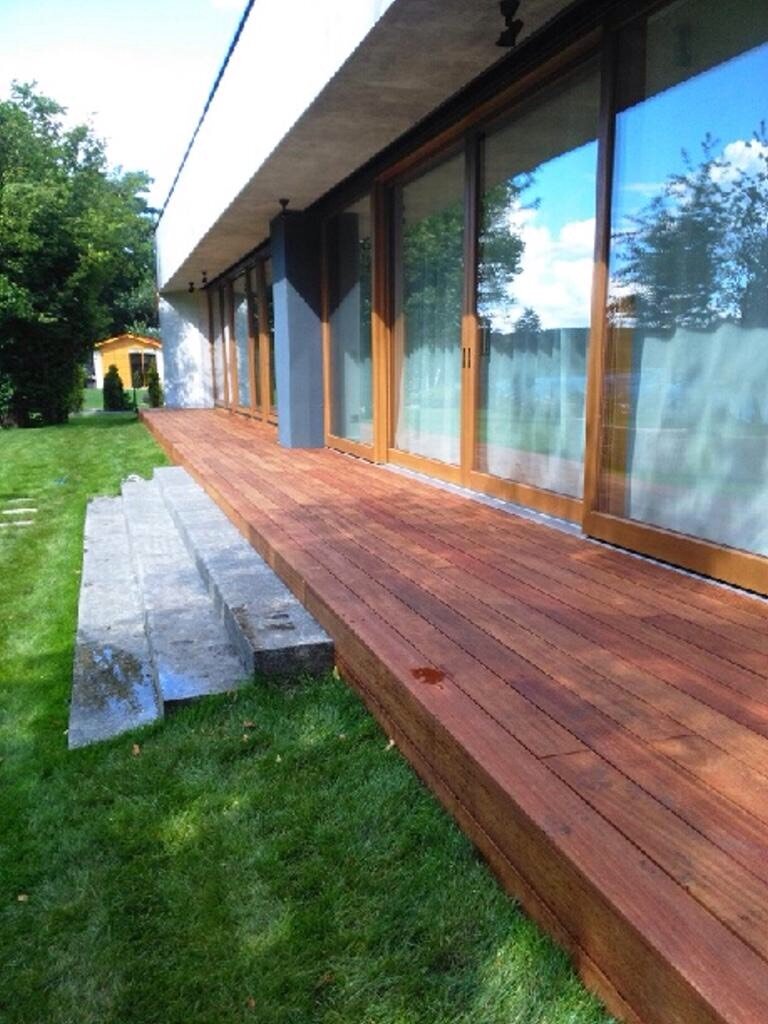
4. Wooden boards: Warmth and natural comfort
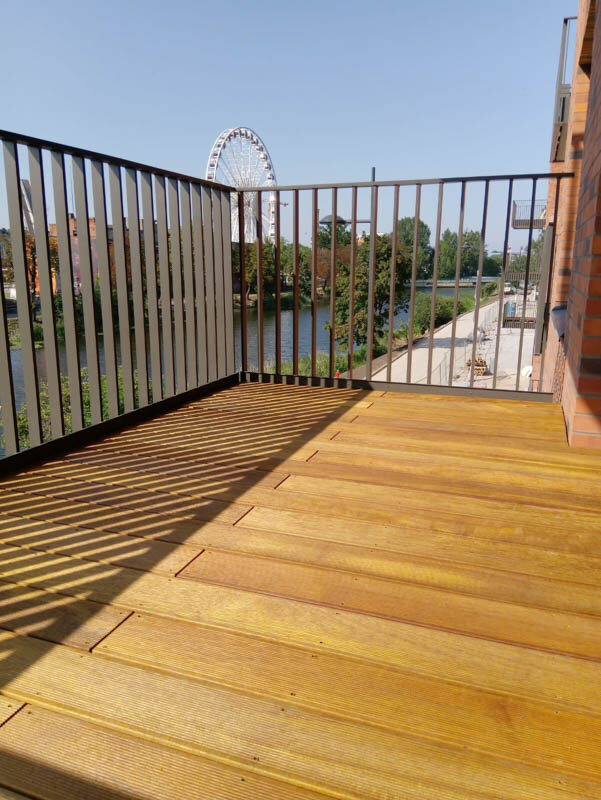
Wooden boards bring natural warmth, acoustic damping underfoot, and the classic aesthetics of outdoor living to modern spaces. Wooden surfaces on pedestals typically come as prefabricated modular wooden tiles or traditional decking boards mounted on raised joists.
Why it works well on pedestals
- Tactile comfort: Wood is natural underfoot and remains comfortable to walk on even in direct sunlight.
- Acoustic absorption: Wood softens the sound of footsteps compared to hard masonry surfaces, which makes it popular on residential balconies.
Potential trade-offs
- Ongoing maintenance: Wood reacts to rain, UV exposure, and temperature changes. Regular oiling, staining, or sealing is necessary to maintain its color and structural integrity.
- Flammability and building regulations: High-rise developments often have strict fire regulations limiting combustible materials on external balconies or roofs.
Comparison of key material characteristics
- Maintenance: Outdoor porcelain requires minimal effort beyond a quick rinse with water. Natural stone requires moderate care, including periodic sealing to protect against stains. Wood requires the most attention, requiring regular oiling or staining to maintain color and integrity.
- Dimensional consistency: Porcelain offers high consistency with precise factory tolerances. Wood provides moderate uniformity, while natural stone varies the most, often requiring shims or precise adjustments during installation.
- Weight: Porcelain and wood fall into the moderate to low weight category, making them versatile in terms of structural constraints. Natural stone is significantly heavier, requiring careful verification of the structure's load-bearing capacity.
- Stain and moisture resistance: Porcelain stands out for its exceptional non-porous resistance. The performance of natural stone depends on the density and sealing of the specific stone, while wood requires sealing to prevent moisture absorption.
- Fire resistance: Both porcelain and natural stone are non-combustible materials. The flammability of wood varies and must be verified in accordance with local building regulations.
5. Composite/WPC Decking Boards: Modern Durability and Low-Maintenance Elegance
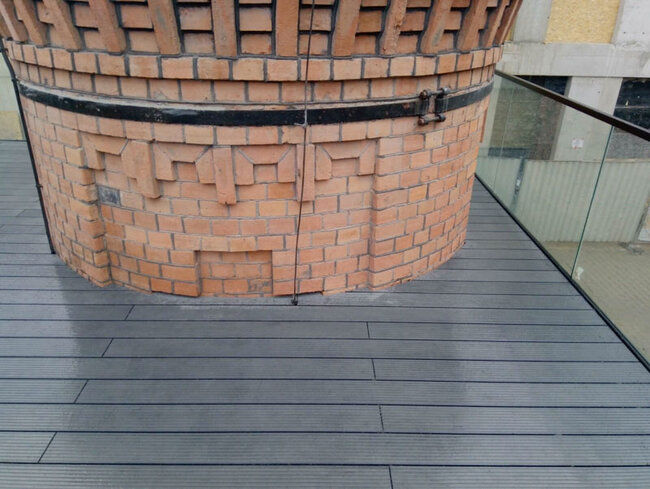
Composite decking boards (WPC – wood-polymer composite) are a popular choice for raised outdoor flooring systems supported by adjustable pedestals. They combine natural wood fibers with synthetic polymers to create a durable, weather-resistant decking surface. While natural wood boards are valued for their organic warmth and rustic charm, composite (WPC) boards stand out for their engineered durability and effortless use.
Why it works well on adjustable pedestals
- Level surface on slopes: Adjustable pedestals easily level uneven or sloping substrates (such as waterproof roof membranes), allowing long composite boards to lay completely flat without deformation.
- Effective ventilation under the deck: Raising the composite boards above the substrate creates continuous airflow beneath them, preventing moisture accumulation, rot and heat buildup under the boards.
- Concealed drainage and installations: Rainwater quickly drains through the gaps between the boards onto the sloping surface below. The void under the deck also conceals pipes, cables and drainage channels, leaving them accessible for maintenance.
- Resistance to rot and insects: Unlike traditional wood, WPC does not rot, crack or attract termites, matching the long service life of high-density polypropylene pedestals.
- Low maintenance requirements: WPC boards do not require staining, sealing or sanding—routine cleaning with water and mild soap is enough.
Potential trade-offs
- Requirement for a substructure (joist system): Unlike thick porcelain or stone pavers with a thickness of $20mm$, which rest directly on the pedestal heads, composite decking boards require a base in the form of a joist grid (aluminium, composite, or wooden joists) supported by pedestals, which increases material and labour costs.
- Thermal expansion and contraction: Composite decking boards expand and contract with temperature changes, which requires precise gap maintenance during installation and appropriate fixing clips.
- Higher initial cost: High-quality WPC decking boards and the required joist structure typically have a higher initial cost compared to standard wooden boards or basic concrete pavers.
- Heat accumulation: Darker composite colours can retain significant amounts of heat in direct sunlight, making the surface hot to walk on barefoot on hot summer days.
How to choose the right material for your project
When matching a deck tile to a system of adjustable pedestals, consider the following key priorities:
- Structural load limits: If you are working on a balcony or upgrading a rooftop terrace with weight restrictions, porcelain tiles or modular wooden boards keep the load low while maintaining stability.
- Maintenance expectations: If your project requires a "set it and forget it" surface, porcelain is unbeatable. If the timeless look of real stone or organic wood better suits your vision, include a maintenance routine in your plans.
- Access under the deck: Because pedestals create a void beneath the floor, any chosen tile can be lifted individually with a tile lifter. However, lighter porcelain tiles make quick plumbing or electrical inspections much easier than heavy stone slabs.
As a manufacturer of adjustable pedestals, our goal is to ensure that regardless of the material you choose — porcelain, stone, or wood — it rests on an even, stable, and well-drained foundation. Matching the deck tile to your maintenance preferences and structural requirements ensures an outdoor space that reliably serves for many years.