Whether you are finishing a backyard garden terrace, laying porcelain tiles on a residential balcony, or installing a 200-square-meter rooftop terrace on a commercial property, raised deck installation comes down to one task: keeping the pavers perfectly level, stable, and drained while the substrate beneath them does what it must do.
Raised deck systems (i.e., "floating" systems) abandon traditional wet mortar beds in favor of open joints that allow rainwater to drain to the waterproofing membrane or shaped substrate below. To suspend the pavers, you generally have two options: simple fixed-height rubber support pads or adjustable terrace pedestals with a screw mechanism.
Both solutions have their place on a construction site. Choosing the wrong one, however, turns an afternoon of clean laying into days of lifting, shimming, wedging, and cursing.
The fundamental difference: static rubber vs. mechanical screws
A fixed-height rubber pad is typically a solid disc made of vulcanized rubber or high-density elastomer, usually between 9 mm and 20 mm thick. It sits directly on the substrate and has integrated spacer tabs (usually 3 mm to 5 mm wide) that automatically set the gaps between pavers. If your surface is flat, stable, and uniform, you place the rubber pad, set the corners of four pavers on it, and move on.
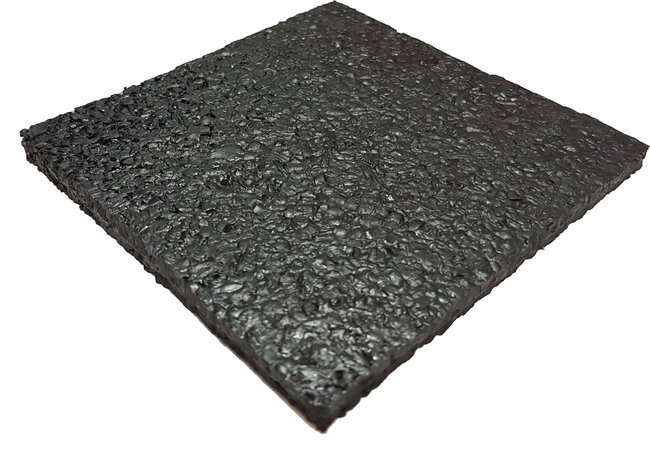
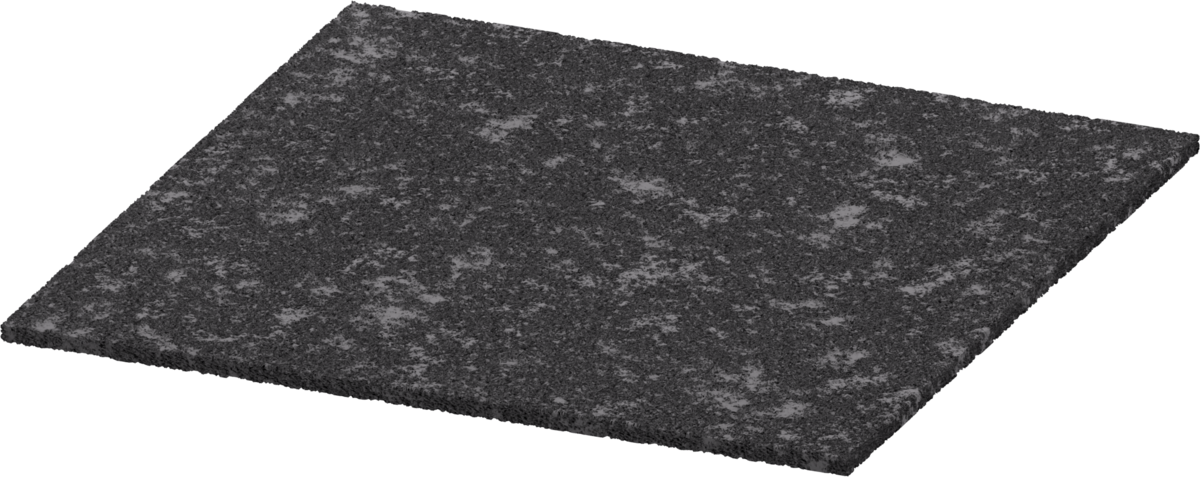
See also: Rubber pad SBR 200×200×3 mm
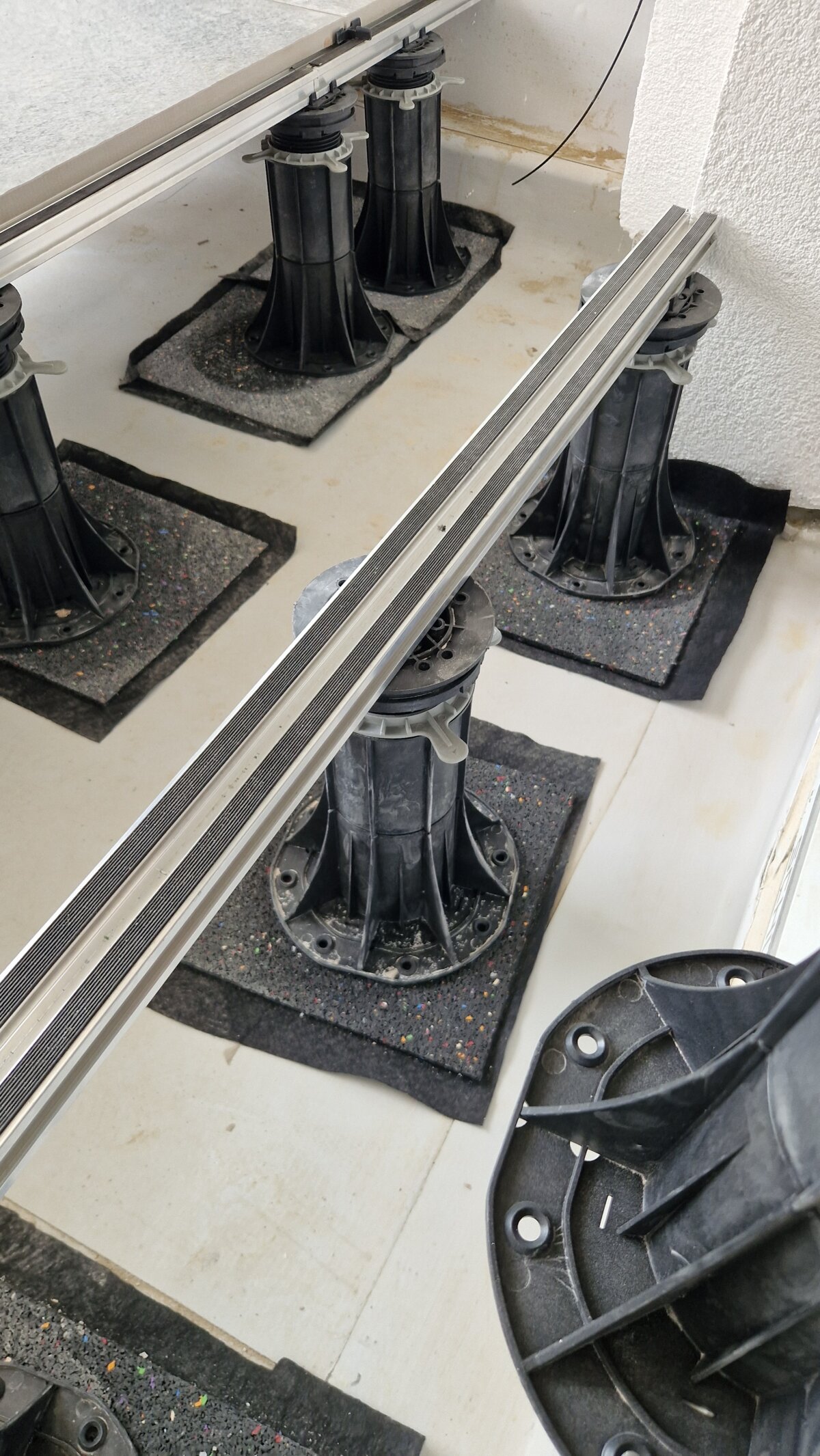
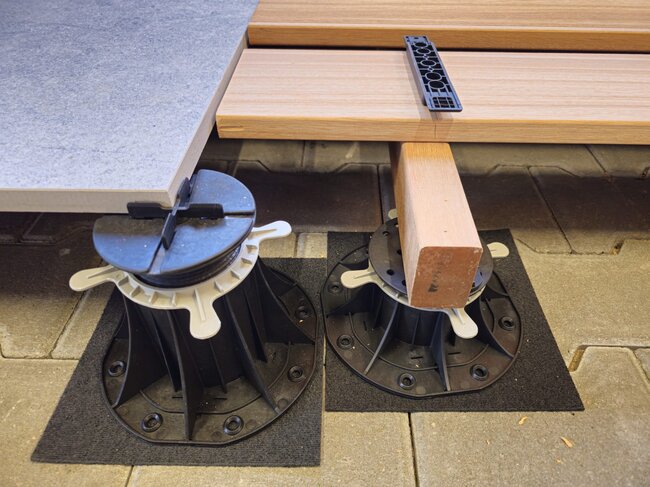
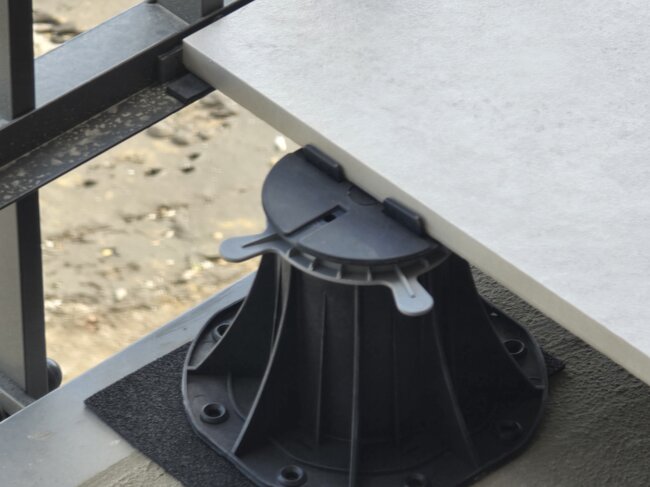
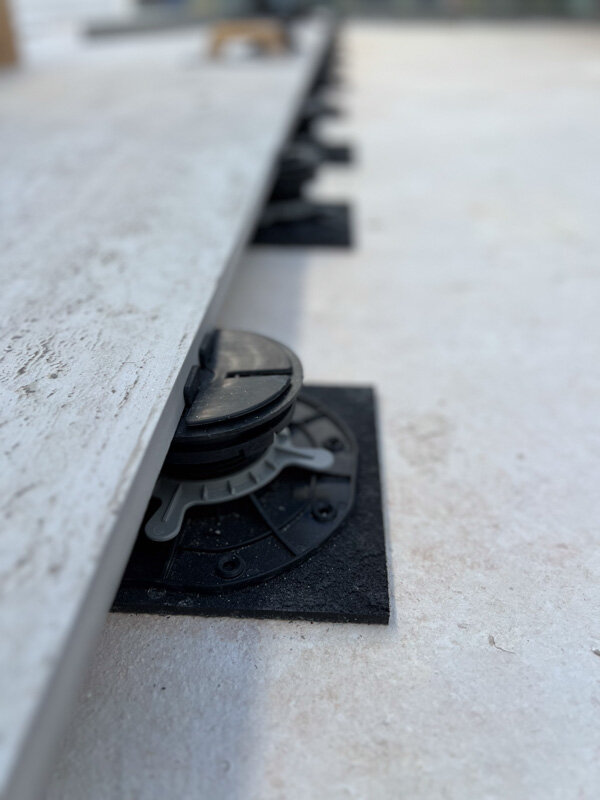
An adjustable plastic pedestal works on the screw mechanism principle. It has a wide load-distributing base, a central threaded column, and a head equipped with spacer tabs and often a non-slip rubber top pad. Turning the column or adjustment ring lets you fine-tune the height millimeter by millimeter. In our production workshop, we design these components to cover ranges from just 15 mm up to 1,000 mm or more using height couplers.
The difference is not just about adjustability. It comes down to how much work a pedestal can do to compensate for the real conditions on your site.
Dealing with slopes, inclines and uneven substrates
Waterproof membranes on roofs and balconies are rarely laid flat. By design, structural slabs incorporate a slope, usually with a gradient of 1:60 to 1:80, to direct water towards roof drains and gutters.
And this is where the paths of the two systems diverge:
- Fixed rubber pads replicate the slope of the slab. If the concrete underneath has a 1.5 degree slope, your finished pavers will have a 1.5 degree slope. If there is a depression in the seam of the torch-on roofing felt, the paver above it will sit in that depression. You can buy thin rubber leveling shims (usually from 1 mm to 3 mm) to level out low points, but stacking multiple shims on top of each other under corners quickly becomes unstable.
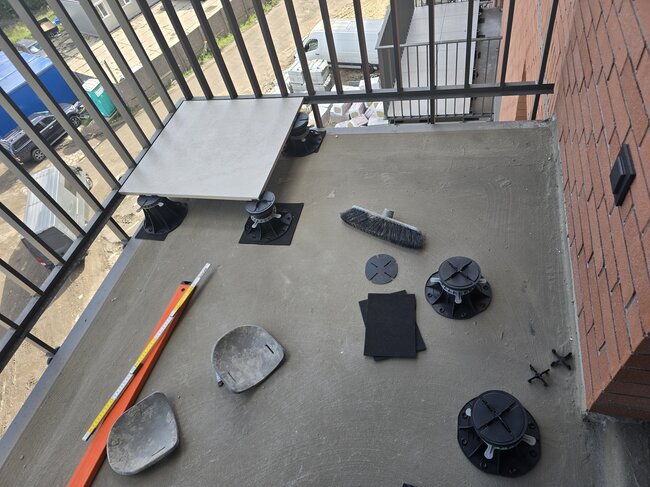
- Adjustable pedestals level the terrace. Because each pedestal moves independently, you can raise a corner at the low end by 40 mm while leaving the high end at 15 mm. The substrate retains its drainage slope underneath, while the walking surface above is perfectly level.
For steeper slopes (above 2%), look for adjustable pedestals with built-in or add-on slope compensators. When designing pedestal heads, we build spherical self-leveling mechanisms into the crown specifically to level out slopes of up to 6% without the installer having to manually balance wedges.
Water clearance depth and drainage
Laying pavers with gaps is based on the fact that water immediately runs off the paver surface and flows through the substrate underneath.
With fixed rubber pads, the clearance is limited to the thickness of the disc — often from 10 mm to 15 mm. On a clean, well-profiled balcony with short runs to a linear drain, 15 mm is sufficient. However, on large flat low-slope roofs, low clearances create two risks:
- Debris blockages: Leaves blown in by the wind, moss and sand washed through the gaps get trapped at shallow rubber pads, creating blockages that cause water to back up.
- Contact with standing water: If intense rain flows in faster than the drains can carry it away, a 10 mm thick rubber pad leaves the underside of the pavers directly in the water.
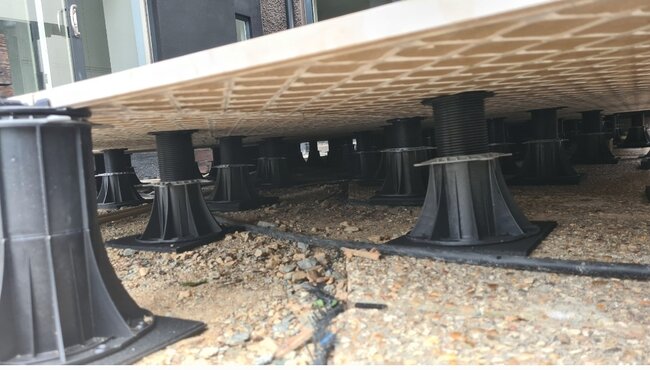
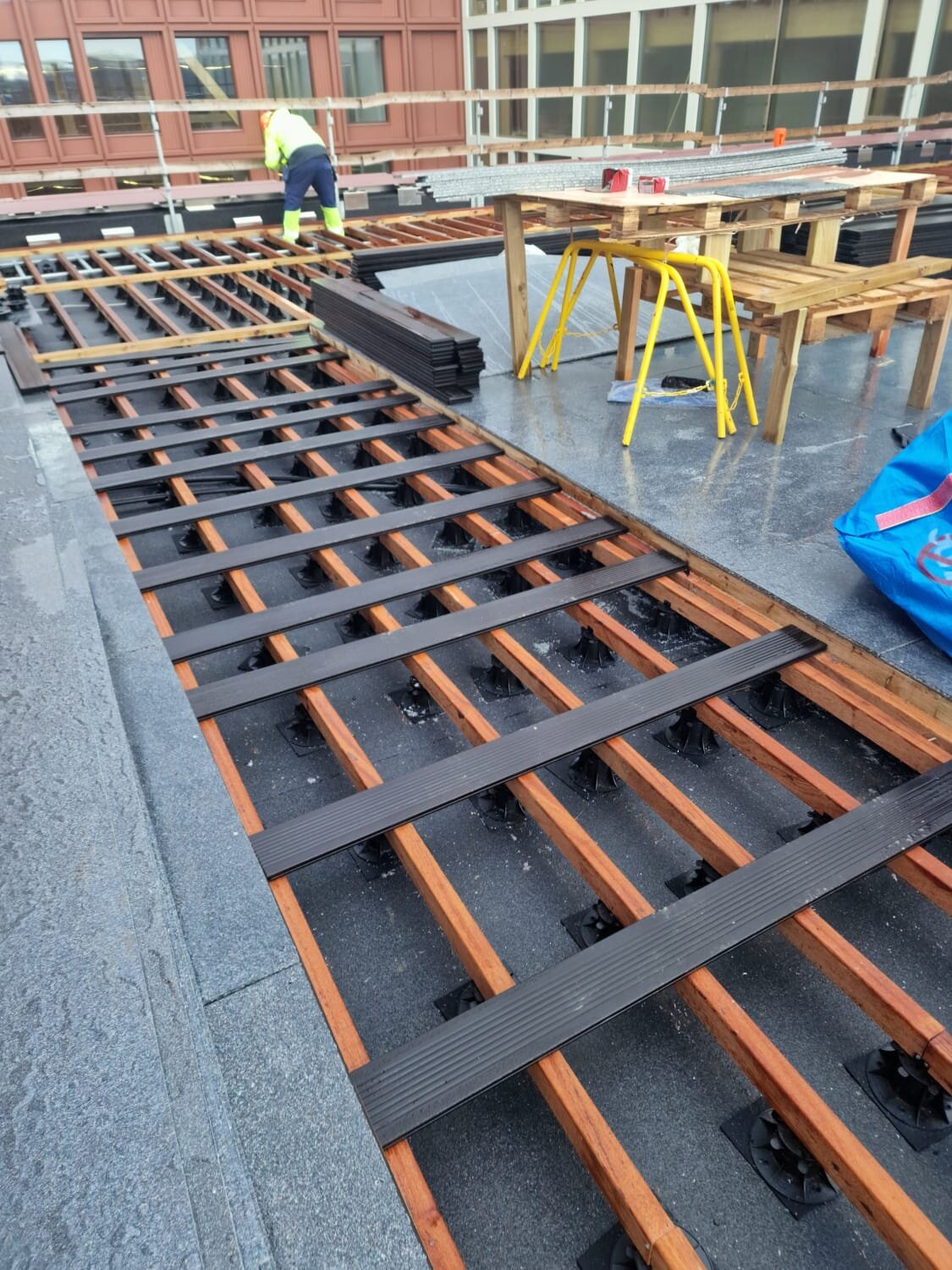
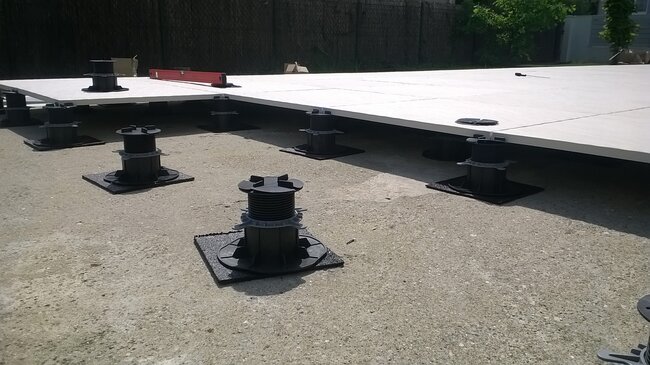
Adjustable pedestals create a spacious void beneath the surface. A 60 mm clearance allows rainwater to flow unimpeded, prevents water from accumulating around the paver gaps and creates a useful hidden space for routing installations such as irrigation pipes, outdoor lighting cables and drainage lines.
Embedding, access and post-installation adjustments
Regardless of how carefully you compact the aggregate or check the structural wooden joists, the substrate moves. The ground settles, the wood shrinks, and the rubber acoustic pads undergo compression over time due to seasonal temperature fluctuations.
If a corner sinks on a surface laid on fixed-height rubber support pads, the repair means lifting the surrounding pavers with a paver lifter, sliding in a rubber shim, checking the level and re-seating the paver. If you shim it 1 mm too high, you have to lift the paver and start over.
Adjustable pedestals give you room to maneuver. Many modern pedestals allow adjustment directly through the open gap with a special key, without lifting the paver. Even if you have to lift the paver to check the roof membrane or clear a drain, an adjustable system lets you put the paver back in place and set the height flush with the substrate with a quarter turn of the collar.
Load Expectations, Paver Types and Thickness
Both options withstand significant downward pressure, but they transfer loads in different ways.
A quality fixed rubber pad distributes weight across a flat, solid profile. The rubber is durable, virtually impossible to crush, provides natural acoustic damping and is perfectly suited to low-clearance residential balconies where dynamic loads are minimal.
Adjustable pedestals transfer weight along robust polypropylene walls. High-grade units are designed to withstand compressive loads of up to 1,000 kg to 2,000 kg per pedestal. This load capacity matters for heavy, dense pavers:
- 20 mm outdoor porcelain: Lightweight and dimensionally precise, but fragile without support. They require a pedestal with a wide head and a central rubber shim under large formats (such as 600 mm x 1200 mm) to prevent cracking under point loads.
- 50 mm concrete paving slabs or thick natural stone: Extremely heavy. They require wide base plates (at least 200 mm in diameter) to spread point loads onto delicate insulation boards or roof waterproofing without puncturing the membrane.
Note: Always verify local building regulations regarding fire resistance classes and wind suction resistance. On high-rise balconies above certain statutory heights, non-combustible Class A metal pedestals are legally required instead of standard polypropylene units.
Cost vs. labour: the real equation
On paper, fixed-height rubber pads look like an easy financial win. A fixed-height rubber pad costs a fraction of the price of a medium-height adjustable pedestal.
The calculation changes when you factor in on-site labour:
- Initial unit cost: Fixed-height rubber pads are cheap to buy upfront, while adjustable pedestals have a moderate or higher unit price.
- Height flexibility: Fixed-height rubber pads remain locked at their factory height, allowing only minimal shimming with thin shims. Adjustable pedestals offer continuous millimetre-by-millimetre control over a wide range, from 15 mm to over 1,000 mm.
- Slope correction: Fixed-height rubber pads replicate whatever slope the terrace already has. Adjustable pedestals can level out gradients of up to 5% when combined with self-levelling heads or slope correctors.
- Void depth: Fixed-height rubber pads create a shallow void (usually under 25 mm), which restricts water flow. Adjustable pedestals create a deep space with ample room for rapid drainage, garden irrigation pipes, and outdoor lighting cables.
- Installation speed on uneven terraces: Laying on fixed-height rubber pads becomes slow and troublesome when you have to shim repeatedly in low spots. Adjustable pedestals are installed much faster because you simply turn the collar to match a laser level or string line.
- Membrane protection: Fixed-height rubber pads naturally protect delicate terrace surfaces thanks to their soft, non-abrasive compound. High-quality adjustable pedestals achieve this with wide, chamfered base plates that distribute large loads evenly without cutting into waterproofing layers.
If the installer spends an extra two minutes per paver lifting, shimming and checking levels with a spirit level, the labour cost completely cancels out the savings from buying cheaper rubber pads.
Which one belongs to your job?
Choose fixed-height rubber pads if:
- The substrate is completely flat, smooth and already slopes in exactly the direction you want water to drain from the finished floor.
- The threshold clearances are small, and the total build-up height between the structural slab and the door threshold is less than 25 mm.
- You are working on a small, sheltered domestic balcony with simple, lightweight tiles.
See also: Rubber pad SBR 170x170x3 mm
Choose adjustable plastic pedestals if:
- The substrate slopes towards the drains, but you want the finished paver surface to be level.
- You need to raise the finished floor to match the internal door threshold.
- The substrate has minor unevenness, steps or depressions requiring quick leveling.
- You are running pipework or garden lighting under the pavers.
- You are laying commercial pavers with high foot traffic, large-format porcelain or deep natural stone.
Before placing an order, measure the finished floor height at the door threshold, check the lowest point at the rainwater drain and calculate the height difference across the entire space. This difference between the lowest and highest point will immediately tell you whether a static rubber pad is enough or whether an adjustable pedestal is needed.